Open-Enrollment Charter Academies & Lottery Intelligence
Texas Charter Schools, Open-Enrollment Academies & Lottery Priority Explorer
Comprehensive guide to Texas open-enrollment charter networks and college preparatory academies. Benchmark statewide admission lotteries, student-teacher staffing ratios, and TEA accountability standards across all twenty education service regions.
STATUTORY MATHEMATICAL BENCHMARK
TEA Domain 1 STAAR & Faculty Ratio Simulator
Computes TEA Domain 1 Student Achievement composite index and campus faculty staffing ratios under official PEIMS accounting rules.
How Do Texas Open-Enrollment Charter Schools and Admission Lotteries Work?
Texas charter schools are tuition-free, state-funded public academies authorized by the Texas Education Agency and State Board of Education under Texas Education Code Chapter 12. Operating with open-enrollment admissions, charter networks like CAN Academy, IDEA, KIPP, and Harmony utilize non-discriminatory lotteries with sibling enrollment priorities.
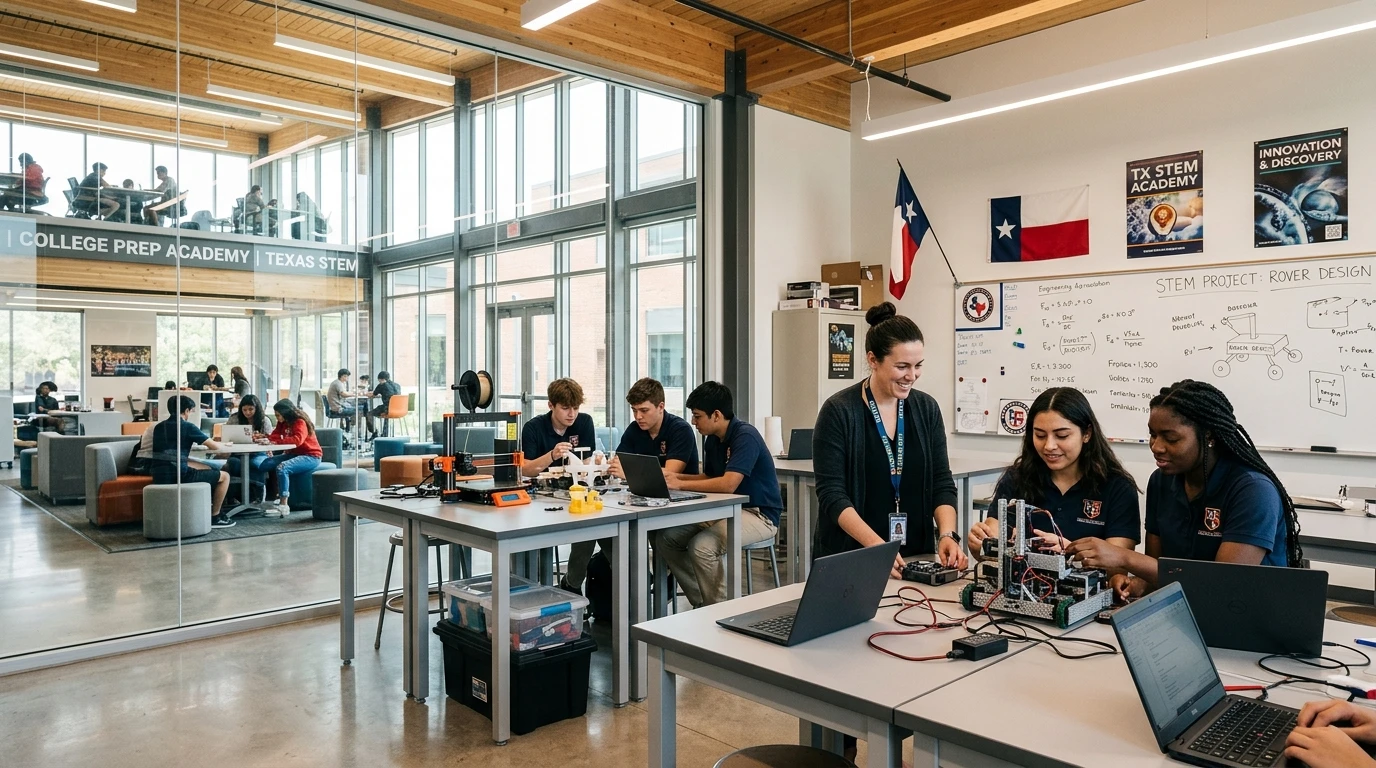
Contemporary Texas STEM charter school robotics lab and secondary classroom
Official Charter Photography
Charter Operational Authority
Authorized under Texas Education Code Chapter 12, open-enrollment charter networks educate over 400,000 Texas students with full public school tuition freedom.
Open-enrollment charter schools in Texas represent an integral pillar of public school choice. While traditional school districts draw students strictly from geographically defined neighborhood attendance zones, open-enrollment charter networks are authorized to accept students across entire metropolitan or county boundaries. Any student eligible to attend a Texas public school can submit an enrollment application to any charter campus without paying fees or tuition.
When the total volume of applications remains within a campus's grade-level physical capacity, all applicants are admitted. However, when demand exceeds available seats—as is routine in high-performing STEM academies and college preparatory networks—state law under Texas Education Code §12.117 mandates a randomized, non-discriminatory blind lottery. Texas law strictly forbids charters from screening students based on academic history, standardized test scores, athletic ability, or special education needs.
State statutes establish transparent priority categories during the lottery execution. Under statutory guidelines, siblings of currently enrolled students receive priority placement to keep family units together on the same academic campus. Children of charter school founders and faculty members may also receive priority seats, provided such allocations do not exceed federal and state percentage thresholds. You can compare how these open-enrollment academies rank against traditional ISD campuses in our master Texas schools directory and campus ratings hub.
Interactive Texas Charter Network & College Prep Campus Finder
Inspect key metrics across top Texas charter systems, including total student enrollment, TEA accountability ratings, teacher staffing counts, and student-teacher ratios. For broader district governance data, consult the Texas Independent School District comparison matrix.
COMPARATIVE ACCOUNTABILITY
Texas Public & Charter Benchmark Matrix
Side-by-side TEA ratings & operational parameters
Educational Entity
Irving ISDSchool Districts
Houston ISDSchool Districts
Katy ISDSchool Districts
Frisco ISDSchool Districts
TEA Accountability Rating
Grade B
Grade B
Grade A
Grade A
Domain 1 Student Achievement
83 / 100
84 / 100
93 / 100
94 / 100
STAAR Approaches / Meets / Masters
76% / 48% / 21%
78% / 52% / 24%
88% / 65% / 36%
91% / 71% / 42%
Student-Teacher Ratio
14.8 : 1
16.2 : 1
15.3 : 1
14.9 : 1
Total Student Enrollment
31,800
189,900
94,500
67,200
2026–2027 Start Date
August 12, 2026
August 12, 2026
August 12, 2026
August 12, 2026
Annual Instructional Minutes
76,125(≥ 75.6k min)
76,995(≥ 75.6k min)
76,125(≥ 75.6k min)
76,125(≥ 75.6k min)
Spring Break Schedule
March 15 – March 19, 2027
March 15 – March 19, 2027
March 8 – March 12, 2027
March 15 – March 19, 2027
Major Texas Charter Networks: CAN Academy, IDEA, Harmony, KIPP & Uplift
The Texas charter ecosystem spans diverse educational models tailored to college preparation, STEM excellence, and alternative dropout recovery. Understanding the distinguishing characteristics of each major network helps families identify the appropriate learning environment:
Texans Can Academies
Founded in 1985, Texans Can Academies operates 13+ dropout-recovery high schools across Dallas, Fort Worth, Houston, Austin, and San Antonio. Classified under Alternative Education Accountability, the network provides four-hour daily scheduling blocks and intense literacy remediation.
AEA Dropout Recovery
IDEA Public Schools
Educating over 80,000 students across the Rio Grande Valley, San Antonio, Austin, El Paso, and Greater Houston, IDEA emphasizes college matriculation, universal Advanced Placement participation, and rigorous mathematics instruction from kindergarten through graduation.
College Preparatory
Harmony Public Schools
Operating 60+ campuses across Texas, Harmony is renowned for its science, technology, engineering, and mathematics curriculum, competitive robotics programs, and project-based instruction. Harmony consistently achieves top-tier TEA Domain 1 ratings.
STEM & Robotics
KIPP Texas
Operating 59 public charter campuses across Houston, Austin, Dallas, and San Antonio, KIPP Texas focuses on foundational literacy, character development, and post-secondary alumni completion programs.
KIPP Forward Program
Uplift Education
Serving 23,000 students across the Dallas-Fort Worth metroplex, Uplift Education provides authorized International Baccalaureate Primary and Middle Years programmes with comprehensive college readiness tracks.
IB World Schools
Charter schedules generally follow standard school operational windows, but many feature extended school days or modified trimesters. Review specific term start dates, breaks, and holiday schedules in our directory of charter school academic calendars and start dates.
General Lottery Selection Probability[probability]
Empirical probability of an unweighted applicant securing a seat in a charter lottery
S_total
Total Available Capacity[seats]
Total grade-level seats allocated by charter board capacity limits
S_sibling
Sibling Priority Allocations[seats]
Guaranteed seats allocated to enrolled students' siblings under TEC §12.117
A_pool
Remaining Applicant Pool[students]
Total general public applications submitted prior to the lottery deadline
Calibrated Example:
120 Total 6th Grade Seats - 45 Enrolled Siblings = 75 Open Lottery Seats. If 300 Non-Sibling Applicants Apply, General Admission Probability = 75 / 300 = 25.0%.
Charter School Accountability: TEA Academic Standards, Financial FIRST & Renewal Mandates
A common misconception is that charter schools operate without regulatory oversight. In reality, Texas charter operators face stricter closure mandates than traditional school districts under the state's Three Strikes Law (Texas Education Code §12.115). If an open-enrollment charter receives an academically or financially unacceptable rating for three consecutive school years, the Commissioner of Education is statutorily mandated to automatically revoke its operating charter.
Every charter network must publish its annual Financial Integrity Rating System of Texas (Financial FIRST) report, verifying fiscal solvency, debt covenant ratios, and administrative cost caps. Furthermore, the Charter School Performance Framework evaluates special education program compliance, ensuring charter campuses provide full Individuals with Disabilities Education Act and Section 504 accommodations without artificial admission barriers.
✓Copied formatted markdown to clipboard!
Frequently Asked Questions About Texas Charter Schools & Academies
01Are Texas charter schools free to attend?
Yes. Open-enrollment charter schools in Texas are 100% tuition-free public schools funded by state and federal tax dollars under Texas Education Code Chapter 12. They cannot charge tuition, and they receive state funding based on Average Daily Attendance (ADA) without levying local property taxes.
02How do charter school lotteries work in Texas?
When applications for a charter campus exceed available grade-level seats, Texas Education Code §12.117 requires an equitable, non-discriminatory lottery. All applications submitted before the priority window are randomized. Students not selected are placed on an indexed waitlist. Sibling enrollment priority and children of charter staff receive statutory preference where authorized.
03Do charter school teachers need state certification in Texas?
Under Texas Education Code §12.129, all charter school teachers must hold at least a high school diploma, and teachers in special education or bilingual programs must hold full Texas state certification. Core subject requirements depend on the school's approved charter agreement, though major networks like IDEA and KIPP require certified staff across foundational courses.
04How does the Charter School Performance Framework (CSPF) operate?
The TEA evaluates charter networks annually through the Charter School Performance Framework (CSPF), assessing three distinct tiers: Academic Performance (STAAR outcomes, graduation rates, federal targets), Financial Performance (Financial FIRST audit metrics, liquidity, debt ratios), and Operational/Governance Compliance (board ethics, special education compliance, PEIMS data accuracy).
05What is Alternative Education Accountability (AEA) for charters like Texans Can Academies?
Alternative Education Accountability (AEA) provisions apply to specialized charter networks—such as Texans Can Academies (CAN Academy)—serving predominantly at-risk student populations (at least 75% at-risk enrollment in grades 6–12). AEA evaluates these dropout-recovery and credit-recovery programs under modified accountability metrics prioritizing graduation rates and credential completion.
🛡️
Privacy & Analytics Transparency
We use privacy-hardened Google Analytics 4 (with IP anonymization and zero ad identifiers) to measure directory performance. No student data is collected. Review our Privacy Policy.